
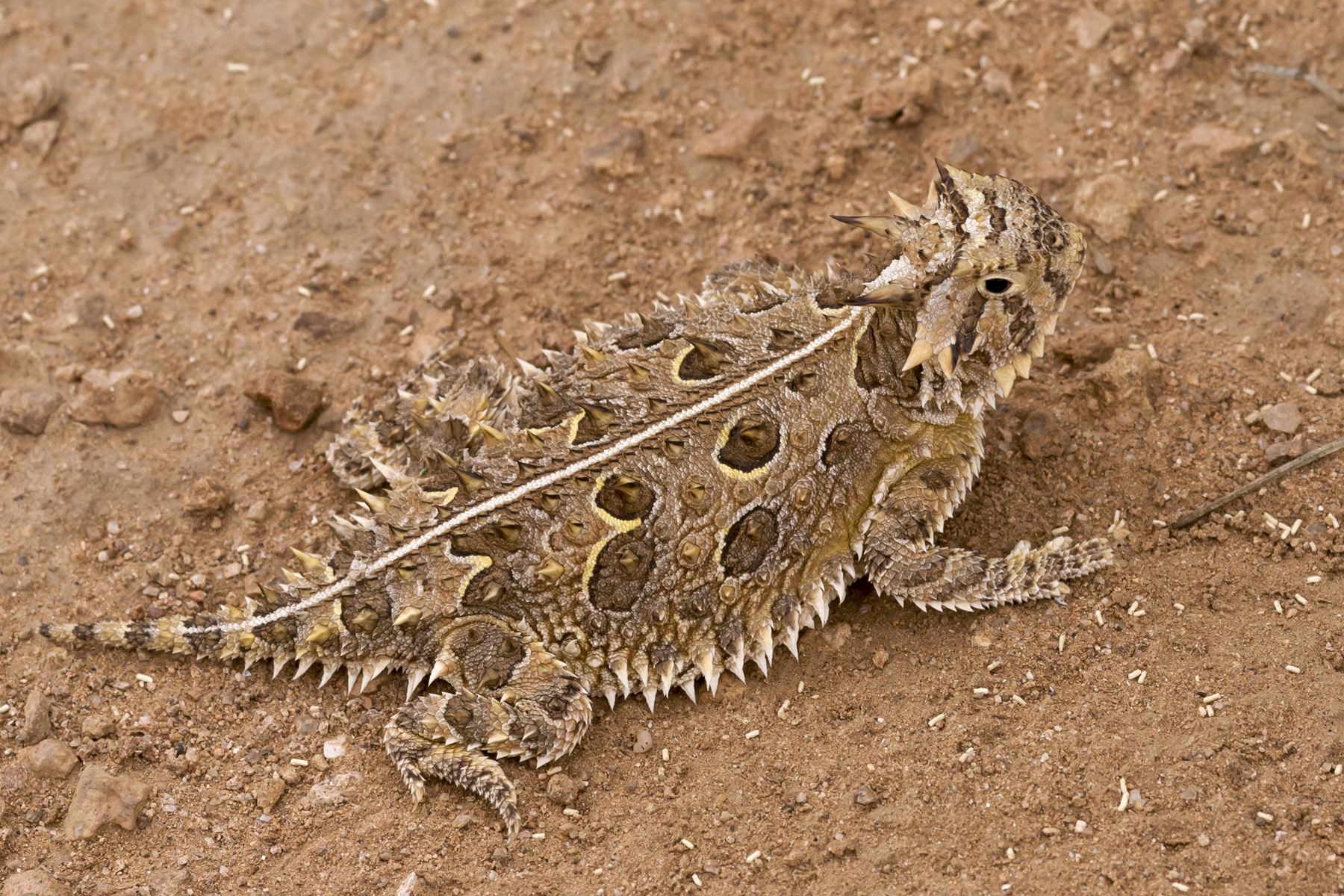

In the arid regions of south-central United States and northeastern Mexico, at altitudes reaching up to 1830 meters, lives one of the most fascinating and bizarre reptiles on the planet: the Texas horned lizard, scientifically known as Phrynosoma cornutum. Famous for its prehistoric appearance covered in spikes, this creature possesses a defense mechanism so radical and surprising that it defies the imagination of any naturalist. When cornered by a predator, this animal is capable of performing an extreme maneuver that involves altering its own blood pressure to spray it directly from its eyes. Although its spiky armor might look intimidating, the true biological nature of this unique reptile involves calm sunbathing habits, specialized diets, and dedicated conservation projects across its natural range.

Quick facts
- Subject: Texas horned lizard (Phrynosoma cornutum)
- Habitat: South-central United States and northeastern Mexico
- Diet: 70% harvester ants
- Jet distance: Up to 1.5 meters
- Weight loss: Up to 6 percent when firing
How Does the Ocular Blood Jet Work?
The most astonishing feature of this species is its ability to defend against canids and other carnivores through an ocular blood jet. The lizard intentionally restricts the blood flow exiting its head, causing a sharp surge in blood pressure. By blocking the vessels that drain blood from the head back into the body, the pressure ruptures tiny capillaries located at the corners of the eyes. As a result, the reptile shoots a jet of blood up to 1.5 meters, or 5 feet, away. Curiously, this blood contains a chemical with a foul taste to canids, which usually causes the attacker to flee in confusion. When executing this eye-firing maneuver, the reptile can lose up to 6 percent of its body weight in a single defensive action.
Anatomy, Sexual Dimorphism, and Specialized Diet
In addition to its surprising defense, the horned lizard displays notable physical characteristics. The species exhibits sexual dimorphism: females reach a snout-vent length of about 13 cm, equal to 5 inches, while males are smaller, measuring close to 9.4 cm, or 3.7 inches. Its body is covered in spiky scales that provide strong passive protection against numerous terrestrial predators. Its diet is highly specialized, with approximately 70% of the Texas horned lizard’s diet consisting of harvester ants, supplemented by termites, beetles, and grasshoppers. To handle this diet, they possess a blood plasma factor that neutralizes ant venom and produce copious amounts of mucus in the esophagus to safely swallow their prey.
Sunbathing Behavior and Natural Habitat
Despite their fierce appearance, Texas horned lizards are extremely docile creatures that require bright sunlight to produce essential vitamin D. Because of this, they are frequently discovered along open rocky areas, dusty roadsides, and open plains where they can bask undisturbed. At night, the lizard buries itself in the sand to stay safe from environmental changes and potential predators. When winter approaches, they hibernate in underground burrows averaging 140 mm in depth, usually oriented towards the south or southwest to capture maximum sunlight. Though they prefer to stay still most of the day, they can dart into thick grass or dig underground rapidly if danger approaches.
The Mystery of Ol’ Rip and Popular Culture
The fame of this animal has transcended biology to enter the folklore and popular culture of the United States. In 1928, a specimen named Ol’ Rip gained national fame after supposedly surviving 31 years buried inside a time capsule in Eastland, Texas. The story caused such a sensation at the time that the lizard even met President Calvin Coolidge in person. Years later, this astonishing urban legend inspired the 1955 animated short film One Froggy Evening, an animation masterpiece that gave birth to the iconic Michigan J. Frog character. Furthermore, the species holds an esteemed place as the state reptile of Texas and appears as a sacred motif in Native American art and traditions.
Modern Conservation Challenges and Research
In recent years, populations of this species have declined significantly due to habitat fragmentation, urbanization, and the widespread use of pesticides. The invasion of nonnative red imported fire ants has further threatened the survival of the lizard by destroying harvester ant colonies, which serve as their primary food source. To combat these threats, specialized breeding and reintroduction programs have been launched by organizations like the Fort Worth Zoo, Houston Zoo, and San Antonio Zoo. Since 2010, the Dallas Zoo has also conducted ongoing mark-recapture studies across a 4700-acre reserve, about 19 square kilometers, in Fisher County, Texas.
Frequently asked questions
How far can the Texas horned lizard shoot blood?
This reptile can launch a stream of blood from the corners of its eyes to a distance of up to 1.5 meters, or 5 feet.
What does this reptile mainly feed on?
Approximately 70% of the Texas horned lizard’s diet is made up of harvester ants, complemented by termites, beetles, and grasshoppers.
How large is the Texas horned lizard?
It exhibits sexual dimorphism: females reach about 13 cm in snout-vent length, while males measure close to 9.4 cm.
We invite you to watch the full video on our YouTube channel @CuriosoyLoco and follow our official Facebook page so you never miss another amazing curiosity.
Sources
- Wikipedia: Texas horned lizard
- Dallas Zoo: Conservation studies in Fisher County