
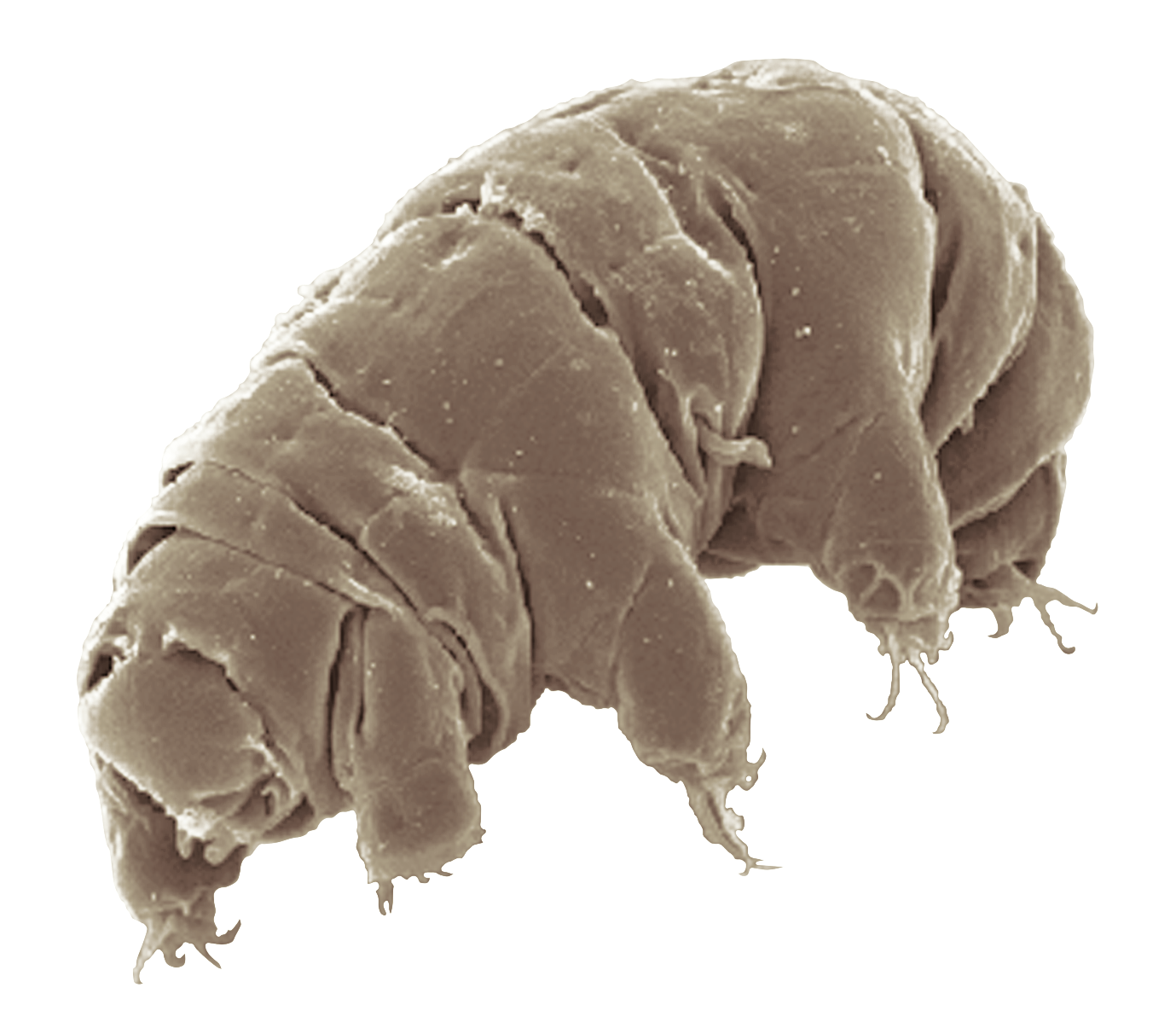

In the vast universe of biology, there are organisms with capabilities so astounding that they seem straight out of the most extravagant science fiction. Among all creatures on Earth, there is one in particular that has baffled biologists and physicists for centuries due to its unimaginable capacity to endure the most horrific conditions in the cosmos. We are talking about the tardigrade, popularly known as the water bear, a microscopic invertebrate whose biological toughness challenges the limits of what we consider possible for animal life.

Quick facts
- Main Subject: Tardigrade (phylum Tardigrada).
- First Discoverers: Johann August Ephraim Goeze (1773) and Lazzaro Spallanzani (1776).
- Known Species: Around 1,500 species within the superphylum Ecdysozoa.
- Fossil Record: Oldest fossil dates back about 500 million years (Cambrian period).
- Key Space Missions: FOTON-M3 mission (2007) and STS-134 on the ISS (2011).
An 18th-century scientific discovery
The history of our understanding of these extraordinary tiny beings began in the late 18th century. In 1773, German zoologist Johann August Ephraim Goeze was the first scientist to formally describe this miniature animal, giving it the Germanic name Kleiner Wasserbär, which translates literally to little water bear. Goeze was fascinated by how this tiny creature paddled its way through freshwater and damp moss.
Just three years later, in 1776, Italian biologist Lazzaro Spallanzani studied these same organisms in greater detail and assigned them the scientific name Tardigrada. This word derives from Latin and means slow steppers, a very accurate description of their slow walking pace. Today, science recognizes around 1,500 known species belonging to the phylum Tardigrada, which is part of the Ecdysozoa superphylum.
Anatomy and ancient origins of the water bear
Despite their extreme survival feats, the physical appearance of the tardigrade is surprisingly modest. When fully grown, these animals generally measure around 0.5 mm in length, making them virtually invisible to the naked eye without the aid of a magnifying lens or microscope. Their cylindrical body features four pairs of unjointed legs, ending in tiny claws or adhesive pads that allow them to hold tightly onto plants and moist surfaces across Earth’s biosphere.
The fossil record demonstrates that these organisms are true survivors of deep time. The oldest known tardigrade fossil dates back to the Cambrian period, approximately 500 million years ago. This means that tardigrade ancestors were already slowly crawling across our planet long before the first dinosaurs appeared, overcoming major mass extinctions throughout Earth’s history with impressive evolutionary plasticity.
Space tests: surviving vacuum and radiation
To test the true limits of tardigrade endurance, the scientific community decided to submit them to the ultimate trial: outer space. In 2007, a sample of 30 adult tardigrades and 30 dehydrated eggs was launched into space aboard the FOTON-M3 scientific mission. During this orbital experiment, specimens were exposed directly to the vacuum of space and intense levels of solar and cosmic radiation. To the world’s surprise, upon returning to Earth and being rehydrated, the tardigrades revived and even produced viable offspring.
Years later, in 2011, tardigrades returned to orbit aboard space shuttle mission STS-134 bound for the International Space Station. The primary objective of this new flight was to analyze the impact of prolonged microgravity and cosmic radiation on their physiology. Once again, these indestructible organisms demonstrated an impeccable ability to survive in the hostile environment of outer space, thanks to a metabolic process known as cryptobiosis in which they suspend virtually all vital functions.
From scientific labs to popular culture
The charm surrounding the water bear is not limited to biology laboratories. Its clumsy crawling style, combined with its legendary ability to emerge victorious from destructive environments, has propelled it into science fiction and modern pop culture. Today, it is common to find tardigrade imagery decorating clothing, crafted into collectible statues, made into plush toys, and even turned into handmade crochet patterns shared by craft enthusiasts worldwide.
Frequently asked questions
Who first discovered the tardigrade?
It was first described by German zoologist Johann August Ephraim Goeze in 1773, who initially named it Kleiner Wasserbär (little water bear).
How large is a fully grown tardigrade?
A fully developed tardigrade usually measures around 0.5 mm long, requiring a microscope to observe its features in detail.
Can tardigrades really survive in outer space?
Yes, real experiments on the FOTON-M3 mission in 2007 and STS-134 in 2011 proved they can endure the vacuum of space, cosmic radiation, and microgravity.
If you love science and the world’s most surprising facts, don’t forget to watch our video on YouTube channel @CuriosoyLoco and follow our official Facebook page for more updates!
Sources
- Wikipedia: Tardigrade
- Jönsson, K. I., et al. (2008). Tardigrades survive exposure to space in low Earth orbit. Current Biology.