
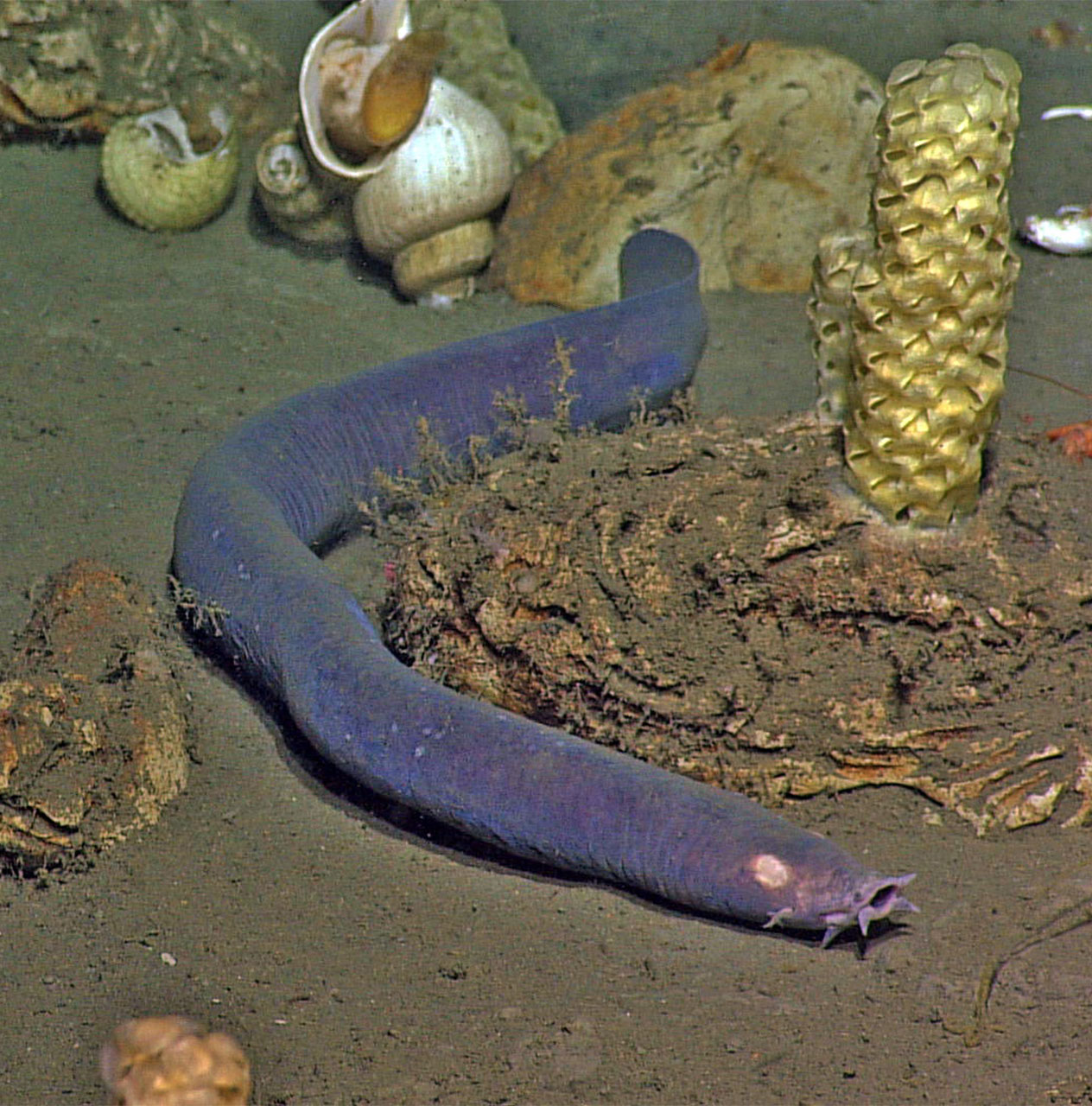

The Fascinating and Slimy World of the Hagfish
In the dark depths of the ocean lives a marine creature so bizarre it looks straight out of science fiction: the hagfish. Belonging to the class Myxini (also known as Hyperotreti) and the order Myxiniformes, these eel-shaped jawless fish are often colloquially referred to as slime eels. Hagfish hold a unique distinction in animal biology, as they are the only known living animals that possess a skull but lack a true vertebral column, featuring only rudimentary vertebrae.

Far from being a typical fish, the hagfish stands out for its extreme biological traits, the most famous being its overwhelming ability to generate a gelatinous substance when threatened. Their fossil lineage traces back to the late Carboniferous period, approximately 310 million years ago, with early stem species such as Myxinikela siroka. Modern representatives were first recorded in the mid-Cretaceous around 100 million years ago. Historically, their classification proved challenging, even being placed in the category Vermes by Carl Linnaeus in 1758.
Today, genetic evidence confirms that hagfish and lampreys are closely related sister taxa within the superclass Cyclostomi. Their elongated, worm-like bodies allow them to thrive as deep-sea predators and scavengers. Their survival in harsh marine environments makes them a paramount subject of evolutionary biology.
Quick facts
- Subject: Hagfish (Slime eel)
- When: 2017 (highway accident)
- Where: U.S. Highway 101, United States
- Most striking figure: Slime expands 10,000 times in 0.4 seconds
n
A Sticky and Instant Defense Mechanism
When a predator approaches with hostile intentions, the hagfish deploys its most astonishing defense mechanism. Upon contacting sea water, specialized slime glands in its skin release a milky, fibrous fluid. This mucus expands up to 10,000 times its original size in just 0.4 seconds, forming a viscoelastic substance that entrains water within thin alpha-keratin filaments secreted by gland thread cells.
This slime immediately clogs the gills of predatory fish and halts their respiration, forcing them to release the hagfish to avoid suffocation. Rheological investigations reveal that hagfish slime viscosity increases under elongational flow, favoring gill clogging in suction-feeding predators. Because of this formidable defense, very few marine predators target the hagfish, though birds and marine mammals occasionally hunt them.
However, using this defense creates an obvious problem for the animal itself: the risk of suffocating in its own mucus. To solve this and scrape off the remaining slime after an attack, the hagfish performs a unique gymnastic trick. It ties itself into a tight slipknot that it smoothly slides from its head all the way to the tip of its tail, clearing its branchial openings.
The Day a Highway Covered in Slime
The viscous nature of these animals made international headlines in 2017. A traffic accident on U.S. Highway 101 resulted in the spill of no less than 3,400 kg (7,500 pounds) of hagfish being transported in a commercial truck. The startled animals released vast quantities of their signature slime across the asphalt.
The resulting gel covered the entire roadway and enveloped a nearby car in a thick, slippery layer. Authorities were forced to close traffic lanes for hours and bring in heavy equipment to clear the viscous substance from the highway. This unusual incident demonstrated to the public the impressive scale of the hagfish defensive mechanism outside its underwater habitat.
Bizarre Anatomy, Degenerate Eyes, and Blood-Filled Skin
The size of these creatures varies remarkably depending on the species. While typical hagfish measure around 50 cm in length, the largest specimen ever officially recorded belongs to the species Eptatretus goliath, reaching an impressive 127 centimeters. On the opposite end, modestly sized species such as Myxine kuoi and Myxine pequenoi do not exceed 18 centimeters, with some individuals measured at just 4 centimeters.
Their skin is scaleless, dull pink to blue-grey in color, sometimes featuring black or white spots, and fits loosely over the body like a baggy sock. The skin attaches to the underlying body only along the dorsal ridge and at the slime glands. Uniquely, the subcutaneous space holds nearly one-third of the animal’s total blood volume, giving the impression of a blood-filled sack that absorbs predator bites without damaging internal organs.
Hagfish lack true fins and possess a paddle-like tail. Their mouth is flanked by six or eight sensory barbels and features a single nostril. Instead of vertically moving jaws, they utilize horny, comb-shaped keratin teeth mounted on cartilaginous plates that protract and retract horizontally. Furthermore, their eyes are simple eyespots lacking lenses or extraocular muscles, unable to resolve detailed images. Paleontological evidence indicates that ancestral hagfish possessed complex eyes that degenerated over evolutionary time.
Extreme Physiology, Anoxic Respiration, and Auxiliary Hearts
Beyond its defense, the internal anatomy of the hagfish is worthy of intense study. It possesses the highest blood volume per body mass of any chordate vertebrate, registering a notable 17 milliliters of blood per every 100 grams of body mass. Additionally, hagfish display exceptionally low blood pressure and are the only known vertebrates with osmoregulation isosmotic to seawater, maintaining blood plasma similar to marine invertebrates.
The circulatory system features a true innervated heart supplemented by several accessory pumps throughout the body that function as auxiliary hearts. For respiration, water enters through the pharynx and travels through internal gill pouches, which range from 5 to 16 pairs depending on the species. In the genus Myxine, these pouches merge into a single ventral branchial opening, accompanied by a pharyngocutaneous duct that flushes large particles from the pharynx.
When buried in oxygen-depleted marine sediment, an extensive network of dermal capillaries supplies oxygen directly through the skin. Hagfish display extraordinary hypoxia tolerance driven by a robust anaerobic metabolism. Laboratory studies have shown that hagfish can survive up to 36 hours in water completely devoid of dissolved oxygen and achieve a full recovery.
Voracious Feeding: Devouring Prey from the Inside Out
While polychaete marine worms on the sea floor are a primary food source, hagfish are opportunistic scavengers and active predators. Their diet encompasses shrimp, hermit crabs, cephalopods, brittle stars, bony fish, sharks, seabirds, and whale carcasses. They are notorious for entering the body cavities of dead or dying sea creatures to devour them from the inside out.
To tear flesh from large carcasses, hagfish utilize their slipknot behavior in reverse, moving the knot from tail to head to generate mechanical leverage against the food. They lack a true acidifying stomach with hydrogen potassium ATPase; instead, their gut operates as a protostomach performing the combined functions of stomach, pancreas, and intestine. Food within the digestive tract is encased in a permeable membrane similar to the peritrophic matrix of insects.
Hagfish are also capable of absorbing dissolved organic matter directly through their skin and gills, maximizing feeding opportunities. Their sluggish metabolism enables them to survive for months between feedings. Additionally, they actively hunt burrowing species like the red bandfish (Cepola haastii) by suffocating them with slime inside their burrows. This aggressive feeding behavior frequently frustrates trawler fishermen, as hagfish can ruin entire net catches before they reach the surface.
Reproductive Mysteries and Potential Biotechnologies
Hagfish reproduction remains largely mysterious due to the challenges of studying their deep-sea habitats. In wild populations, females generally outnumber males. Some species remain sexually undifferentiated prior to maturity, carrying hermaphroditic gonadal tissue. Females lay between 1 and 30 tough, yolky eggs equipped with Velcro-like tufts that anchor them together in rocky crevices or burrows.
Unlike lampreys, hagfish do not undergo a larval stage, and embryos can develop for up to 11 months before hatching. They possess a unique genome containing microchromosomes that are discarded during somatic cell development and retained only in reproductive organs. Furthermore, their pituitary glands secrete gonadotropins, indicating an early evolutionary version of the hypothalamic-pituitary-gonadal axis.
Far from remaining a simple zoological curiosity, modern science studies this organism thoroughly. The alpha-keratin proteins in hagfish slime filaments transform from an alpha-helical structure to a rigid beta-sheet structure when stretched. Through draw-processing and chemical crosslinking in laboratory settings, recombinant slime keratin forms ultra-strong fibers with an elastic modulus reaching 20 GPa, offering a viable alternative to spider silk for advanced body armor and lightweight biomaterial applications.
Frequently asked questions
Why doesn’t the hagfish suffocate in its own slime?
To avoid suffocating in its own mucus, the hagfish ties itself into a tight slipknot that it slides from its head to its tail, mechanically stripping away excess slime from its body and gill openings.
How much does the slime expand in water?
Upon contacting sea water, the protein-rich mucus secreted by the hagfish’s skin glands expands up to 10,000 times its original volume in just 0.4 seconds.
What happened on U.S. Highway 101 in 2017?
A truck carrying 3,400 kg (7,500 lbs) of hagfish was involved in a traffic accident. The stressed hagfish released massive amounts of slime that completely covered the road and a nearby car.
Do hagfish have a spine or normal eyes?
Hagfish possess a cartilaginous skull but lack a true backbone, having only rudimentary vertebrae. Their eyes are simple eyespots without lenses that merely detect light, though ancestral fossils show their ancient relatives had complex eyes.
How do hagfish feed on large marine animals?
Hagfish enter the bodies of dead or dying animals to devour them from the inside. They form a reverse slipknot (tail to head) to leverage force and tear off flesh using their comb-shaped keratin teeth.
Sources
- Wikipedia: Hagfish