
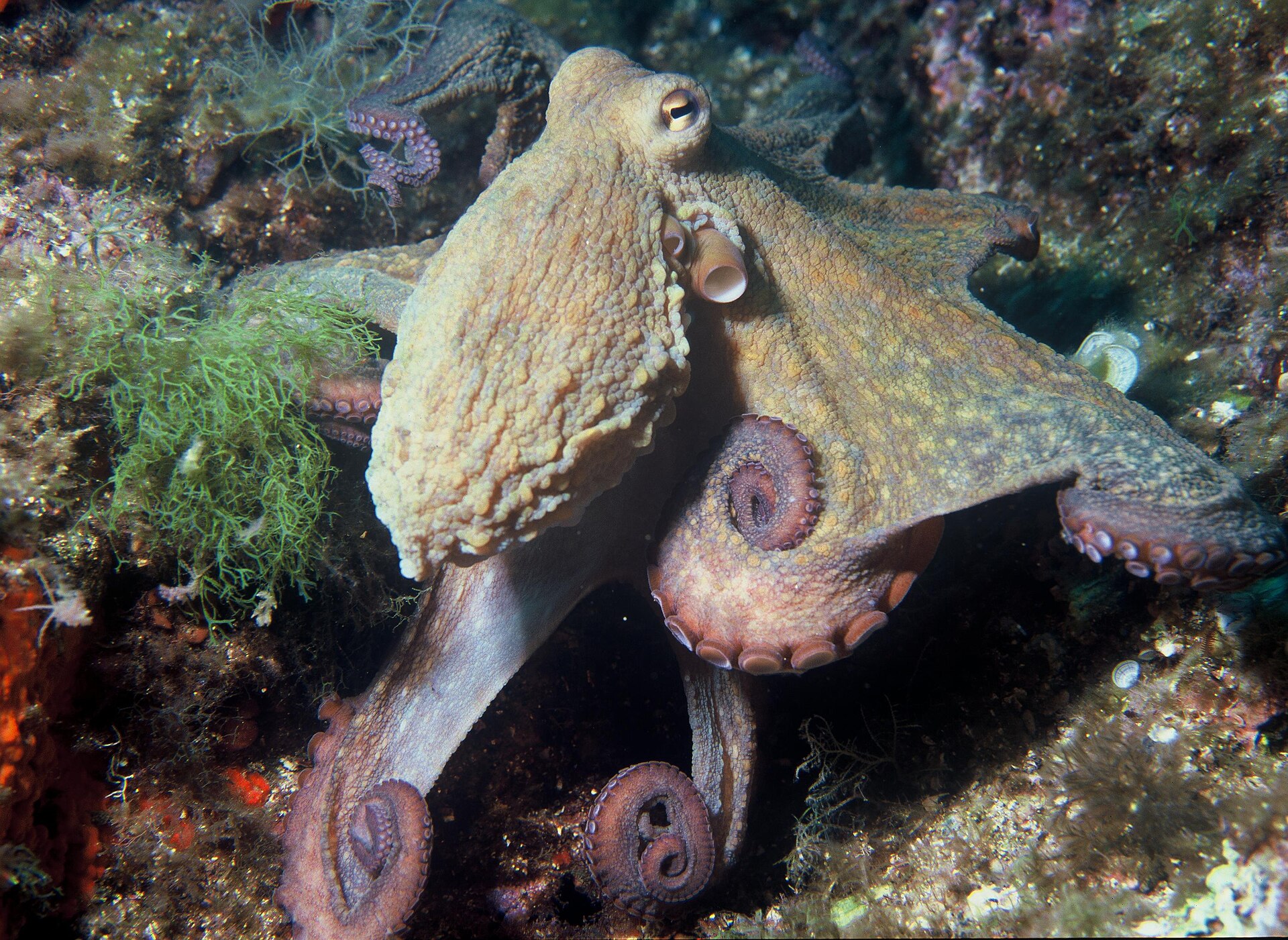

If a being from another planet ever landed on Earth, it would probably look a lot like an octopus. Three hearts, blue blood, arms that “think” for themselves and skin that changes color in an instant. All of that without a single bone.
3
hearts
≈500 M
neurons
2/3
of them in the arms
Three hearts for one body
An octopus has two branchial hearts, which pump blood through the gills to pick up oxygen, and one systemic heart, which sends it to the rest of the body.
The strangest part is that the systemic heart stops beating while the octopus swims. That is why swimming exhausts it so much and, whenever it can, it prefers to crawl along the seabed.
Why is its blood blue?
Our blood is red because it carries oxygen using hemoglobin, an iron-based protein. The octopus uses hemocyanin, which is based on copper and turns blue when it binds oxygen. This protein works especially well in cold, low-oxygen water, exactly where many octopus species live.
Two thirds of its neurons are not in its head, but spread across its eight arms.
Arms that think for themselves
A common octopus has around 500 million neurons, roughly as many as a dog. But about two thirds of them are in its arms. Each arm can explore, touch and react almost independently, and its suckers are packed with chemical receptors: the octopus literally tastes what it touches.
A master of disguise… that can’t see color
Thanks to thousands of cells called chromatophores, an octopus can change its color and texture in a fraction of a second to blend in. The surprising part is that most octopus species have only one type of photoreceptor in their eyes, so in theory they shouldn’t be able to tell colors apart. How they manage to match their surroundings is still being researched.
Did you know…?
The only hard part of an octopus’s body is its beak. That means it can squeeze through any hole its beak fits through, even one far smaller than its body.
Test what you have learned
True or false?
1An octopus has a single, very large heart.
False. It has three: two branchial hearts and one systemic heart.
2Octopus blood is blue because it uses copper to carry oxygen.
True. It uses hemocyanin, a copper-based protein.
3Most of an octopus’s neurons are in its head.
False. About two thirds are spread across its arms.
Image: common octopus (Octopus vulgaris). Photo by Albert Kok, public domain, via Wikimedia Commons.