
What is the Darvaza Gas Crater and Where Is It Located?
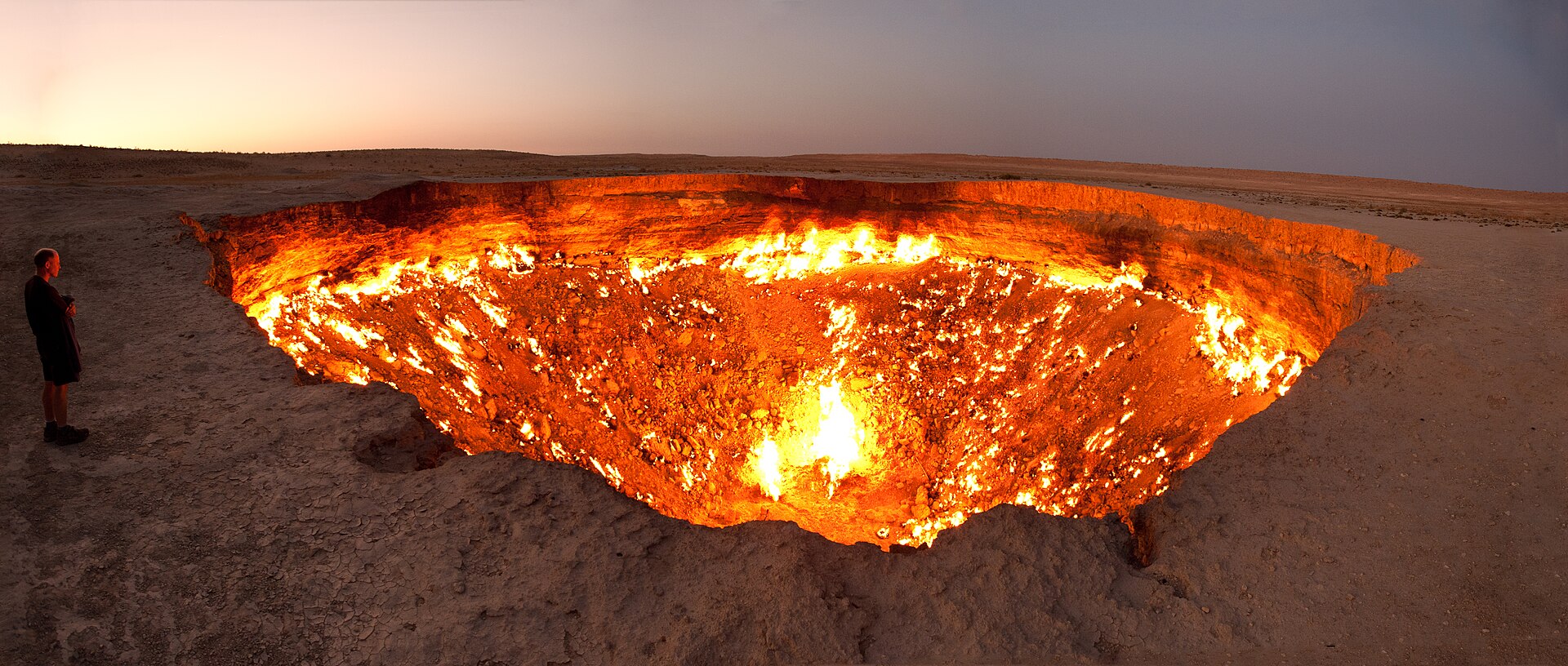
The Darvaza gas crater, officially known as the Shining of Karakum and widely known as the Door to Hell or Gates of Hell, is one of the most fascinating and bizarre geological phenomena on Earth. This impressive burning natural gas field is located in the remote Karakum Desert of Turkmenistan, near the village of Darvaza, about 260 kilometers north of the capital, Ashgabat. The pit has a diameter of 60 to 70 meters and reaches a depth of about 30 meters, creating a mesmerizing spectacle of continuous fire that glows intensely in the dark desert.

Unlike other formations, this crater is a natural gas field that collapsed into a cavern, allowing hundreds of natural gas fires to illuminate both the floor and the rim of the crater. It is not the only one in the area; there is another nearby gas crater that is fenced off and emits a distinct, pungent odor.
The 1971 Calculation Error and the Start of the Fire
The most widespread theory regarding the origin of this abyss points out that in 1971 a group of Soviet engineers was drilling for oil in the area. During the operations, the machinery accidentally pierced a large underground cavern full of natural gas, causing the roof of the cavern to collapse and swallow the drilling rig. Fearing that the pocket would release deadly poisonous gases affecting nearby populations and livestock, the experts decided to set it on fire deliberately, convinced that the gas would burn out completely within days.
However, the engineers drastically underestimated the massive volume of gas trapped beneath the surface. What was planned as a short-term flare-off became an eternal fire that has been burning since 1971, defying initial expectations and becoming a global geological landmark.
Mystery Records and the Historic Descent
Despite the site’s fame, initial historical records about the crater’s collapse remain classified, missing, or inaccessible to the general public. In fact, some local geologists maintain an alternative timeline, claiming the ground actually collapsed in the 1960s and the fire was lit only in the 1980s to prevent the emission of poisonous gases. Whatever the exact date of its ignition, the abyss defied science for decades until, in 2013, explorer George Kourounis became the first person to descend to the bottom of the crater.
For this expedition, sponsored by National Geographic and featured in the series Die Trying, Kourounis used a custom-made Kevlar harness, Technora ropes, and a full-body aluminized suit with a self-contained breathing apparatus. The goal was to collect soil samples for the Extreme Microbiome Project to study microbial life surviving in such scorching temperatures. Since then, the explorer has expressed a desire to descend into the crater again, carrying more equipment for better profiling of the local biome.
Geopolitics, Tourism, and Presidential Stunts
The crater has also starred in bizarre moments far outside pure geology. In 2019, then-president Gurbanguly Berdimuhamedow suddenly appeared on Turkmen state television performing stunts behind the wheel of an off-road truck around the flaming pit. The unusual goal of this public demonstration was to flatly deny rumors about his own death circulating online, though the footage was cut in a way that he was never actually seen driving near the crater itself.
Visiting the site is a complex task, as all foreigners need a visa to enter Turkmenistan and the crater is approximately a four-hour drive from the capital. Despite these challenges, after the region was declared a natural reserve in 2013, it became a major tourist attraction. Visitors usually find a crude road without signage and yurts set up nearby. In 2018, the gas crater was even used as an overnight stop for the Amul-Hazar automobile rally.
Efforts to Control the Burn and Environmental Impact
In recent years, the environmental impact of the pit has drawn scientific attention. As early as 2010, President Berdimuhamedow suggested limiting the crater’s influence on the development of other natural gas fields. By 2022, the government announced plans to extinguish the crater due to deleterious effects on local health, the environment, and the natural gas industry. A commission was established to find the optimal technique, given that Turkmenistan has one of the highest levels of global methane emissions according to the International Energy Agency.
These efforts have yielded visible results: between 2023 and 2026, heat intensity dropped by over 75% according to an analysis by Capterio. By 2025, authorities declared that the size of the fire had been reduced three-fold, with several wells drilled around the crater to capture methane. According to Carbon Mapper data, the crater emitted an average of about 1,300 kilograms of methane per hour from 2022 to 2025, peaking at 1,960 kg/h in October 2025. By August of that year, the site, once a top tourist attraction, showed only a few small pockets of fire, and infrared images from 2026 confirm that the flames are in decline.
Frequently Asked Questions
Who lit the Darvaza crater?
According to the most widespread theory, Soviet engineers in 1971 decided to set fire to the gas after an accidental collapse to prevent a poisoning disaster from the spread of gases.
What are the exact dimensions of the crater?
The pit has a diameter between 60 and 70 meters and an approximate depth of 30 meters in the Karakum Desert.
Will the fire in the crater ever go out?
Yes, between 2023 and 2026 the fire was reduced to a third and its intensity dropped by 75% thanks to the drilling of wells designed to capture methane gas and government efforts to curb emissions.
Sources
- Wikipedia: Darvaza gas crater
- Carbon Mapper: Methane emission reports in Turkmenistan
- Capterio: Natural gas flare monitoring analysis