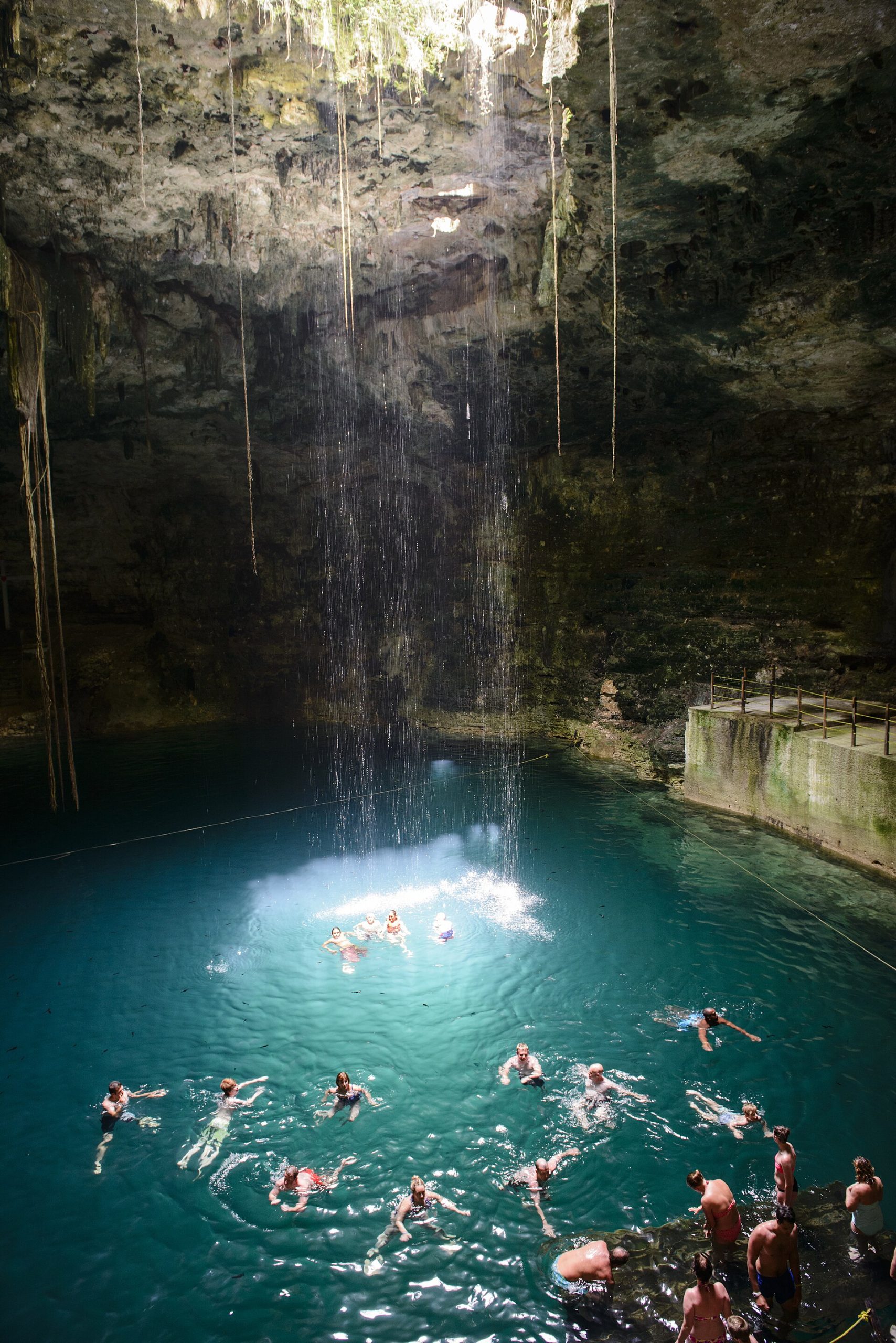

The cenotes of the Yucatán Peninsula hide one of the most intriguing mysteries of pre-Columbian America. For the Mayan civilization, these deep natural sinkholes filled with fresh water were not only vital for survival in a land without surface rivers, but were also considered actual portals to the underworld, known as Xibalba, and the residence of the rain deity Chaac.

Quick facts
- Main Subject: The Sacred Cenote of Chichen Itza.
- Key Investigator: Edward Herbert Thompson in 1904.
- Location: Yucatan Peninsula, Mexico.
- Key Discoveries: Gold artifacts, human bones, mastodon remains, and a 13,600-year-old human skeleton.
- Geological Feature: Circular alignment with the rim of the Chicxulub meteorite crater.
What did cenotes mean to the Mayan civilization?
The word cenote derives from the Yucatec Maya term tsʼonoʼot, referring to any subterranean cavity containing water. It is estimated that around 10,000 cenotes exist across the Yucatán Peninsula. Major Mayan urban centers, such as the famous city of Chichén Itzá, were deliberately built around these natural wells because they served as the primary source of drinking water.
Beyond their practical utility, cenotes played a central spiritual role. Mayan mythology regarded them as sacred gateways connecting the earthly realm to Xibalba, the underworld. Furthermore, the Maya believed that Chaac, the god responsible for bringing rain, dwelled in their dark depths. To gain divine favor during droughts, priests performed intricate religious ceremonies that included offerings of high value.
The 1904 excavation: Edward Herbert Thompson and the Sacred Cenote
For centuries, stories of human sacrifices and treasures submerged in the dark waters were dismissed as romantic folklore by Western scholars. This perspective changed dramatically in 1904 when US diplomat and antiquarian Edward Herbert Thompson, after buying the land encompassing Chichén Itzá, launched an ambitious project to dredge the Sacred Cenote.
Using heavy dredging equipment and diving suits, Thompson extracted human skeletons of men, women, and children from the thick mud. Alongside the bones, he brought up ceremonial gold objects, jade ornaments, ceramics, and carved wooden artifacts. These discoveries irrefutably confirmed the historical reality of the Cult of the Cenote, proving that solemn rituals took place in its depths.
Were human sacrifices performed in all cenotes?
Despite the macabre reputation of the Sacred Cenote, modern underwater archaeology reveals that not all sinkholes shared a sacrificial purpose. Scientific evidence confirms that most cenotes were utilized purely for everyday water consumption and domestic tasks.
A clear example is the cenote at Punta Laguna. Researchers carefully examined approximately 120 human skeletons found at the bottom and determined that none showed signs of sacrifice or ritual violence. These remains represented ordinary burials or drowning accidents, demonstrating that human sacrifices were restricted to specific cenotes of unique religious significance.
Paleontological treasures and the cosmic origin of cenotes
Underwater explorations have uncovered history far older than the Mayan civilization. Between 2001 and 2002, scientific expeditions led by Arturo H. González and Carmen Rojas Sandoval discovered a skeleton named Eve of Naharon in submerged caves, with radiocarbon dating tracing her age back 13,600 years, making her one of the oldest human remains found in the Americas.
Later, in March 2008, cave divers Alex Alvarez, Franco Attolini, and Alberto Nava explored the deep cavern of Hoyo Negro. At a depth of 57 meters, they discovered well-preserved fossils of a Pleistocene mastodon, and at 43 meters, they uncovered a prehistoric human skull of immense scientific value.
Yet the most extraordinary feature of these sinkholes is their spatial distribution. When mapping their geographic density, scientists realized that a prominent circular ring of cenotes aligns precisely with the rim of the Chicxulub crater. This massive impact crater was formed by a giant asteroid 66 million years ago, triggering global climatic shifts and ending the reign of the dinosaurs.
Frequently asked questions
What does the word cenote mean?
It comes from the Yucatec Maya word tsʼonoʼot, which means any natural well or subterranean cavity filled with fresh water.
Who proved that sacrifices occurred at the Sacred Cenote?
US diplomat Edward Herbert Thompson proved the existence of ritual sacrifices by dredging the Sacred Cenote at Chichén Itzá in 1904.
How are cenotes connected to the dinosaur-extinguishing asteroid?
A dense circular ring of cenotes traces the exact fault lines of the Chicxulub crater rim, created by a massive meteorite impact 66 million years ago.
To watch more exciting video content about historical mysteries and science, subscribe to our YouTube channel @CuriosoyLoco and follow our official Facebook page.
Sources
- Wikipedia: Cenote
- National Institute of Anthropology and History (INAH): Submerged Archaeological Research in the Yucatan Peninsula.
- National Geographic Society: Sacred Cenote of Chichen Itza and the Chicxulub Crater ring alignment.