
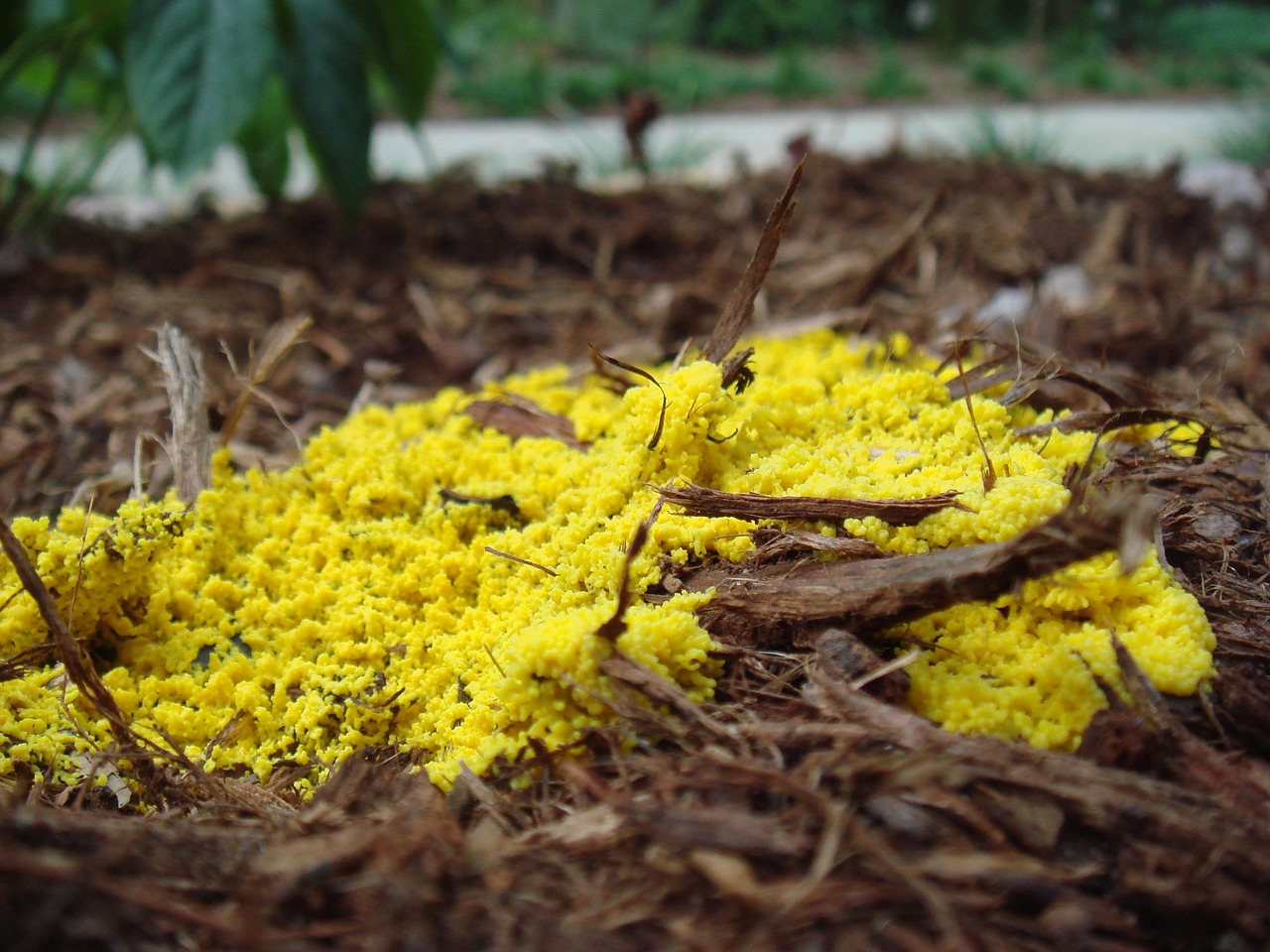

An Astonishing Organism That Defies Biology
Imagine a living organism without a brain, neurons, or a central nervous system that can still solve complex spatial problems, design optimal transport networks, and anticipate the immediate future. This is not science fiction; it is Physarum polycephalum, an acellular slime mold that continues to amaze the international scientific community.
For decades, biologists assumed that navigating complex environments required specialized neural structures. However, this yellow, gelatinous organism has proved that biological intelligence can emerge in forms completely different from traditional animal architecture.
Engineering Without Neurons: The Tokyo Railway Experiment
The turning point in understanding this organism occurred when a joint team of Japanese and Hungarian researchers put its mapping skills to the test. In a landmark 2010 study published in Science, scientists created a scaled map of the Tokyo region inside a Petri dish.
To mimic regional geography, they placed oat flakes—the slime mold’s favorite food—at points corresponding to Tokyo and 36 surrounding cities. They then introduced Physarum polycephalum at the center. What followed left infrastructure engineers stunned.
Initially, the slime mold expanded uniformly across the available space. Within hours, however, it began refining its layout, pruning redundant connections and strengthening direct, resilient pathways between food sources. The resulting network of protoplasmic tubes matched Tokyo’s actual railway system with astonishing accuracy. The mold’s self-organized network exhibited efficiency, fault tolerance, and resource optimization comparable to human engineering designs created over decades.
Global Biological Cartography
The Tokyo experiment was far from a unique fluke. Subsequent tests demonstrated that Physarum polycephalum possesses a generalized ability to model complex networks. When researchers presented the mold with geographical layouts of the United Kingdom and the Iberian Peninsula (Spain and Portugal), it consistently recreated their major highway systems.
The organism achieves this through the rhythmic pulsation of its internal cytoplasm. As fluid surges through its tubular network, mechanical shear stress thickens frequently used pathways while unused channels wither away. In effect, the physics of its body functions as a real-time natural algorithm.
The Mystery of Memory Without a Brain
While network design is impressive, the organism’s capacity for learning and anticipation is even more groundbreaking. Biophysicists at Hokkaido University discovered that the slime mold can anticipate periodic environmental stimuli despite lacking any nervous system.
During lab trials, scientists subjected the mold to regular pulses of cold, dry air every 60 minutes. In response to the unfavorable environment, the mold slowed its movement rate. Remarkable behavior occurred when scientists stopped applying cold air: precisely when the next cycle was due, the mold spontaneously slowed down in anticipation of the cold—a reaction termed spontaneous phase slowing.
The mold repeated this anticipatory deceleration up to seven consecutive times during 10-minute interval tests every hour. This demonstrated a form of cellular memory, unlocking new possibilities in bio-inspired computing and soft robotics operating without microprocessors.
Sources
- Wikipedia: Physarum polycephalum
- Tero, A., Takagi, S., Saigusa, T., et al. (2010). Rules for Biologically Inspired Adaptive Network Design. Science.
- Saigusa, T., Tero, A., Nakagaki, T., & Kuramoto, Y. (2008). Amoeba Anticipates Periodic Events. Physical Review Letters.