
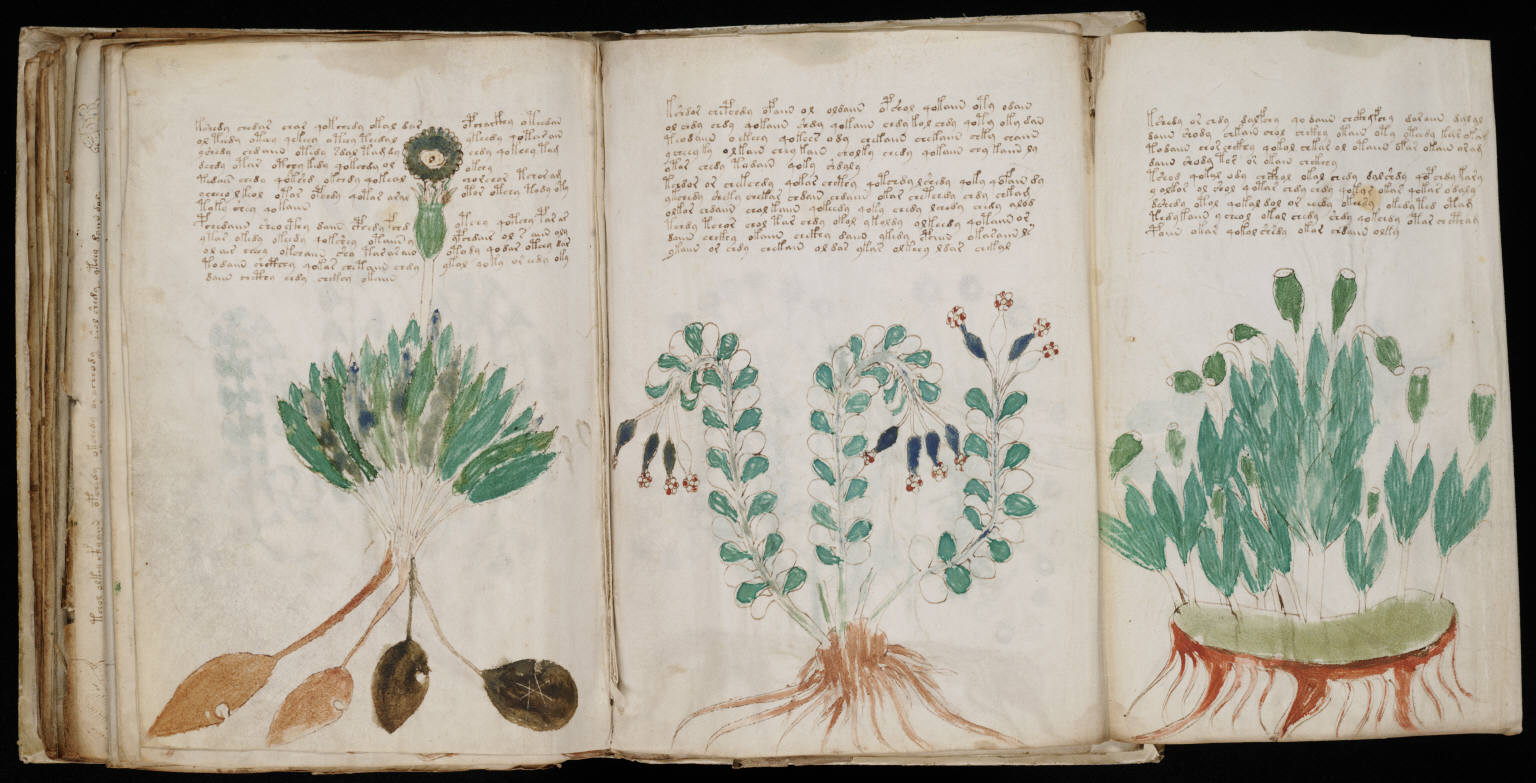

It is about 600 years old, has more than 200 pages full of strange drawings and is written in an alphabet that appears in no other document in the world. Linguists, cryptographers and even wartime codebreakers have tried. Nobody has managed to read it.
≈240
vellum pages
1404–1438
date of the vellum
0
accepted translations
A book written in a language that doesn’t exist
The manuscript is written in a fluent, careful hand, as if its author had fully mastered the script. But its symbols don’t match any known alphabet. Nobody even knows for sure whether it hides a real language, a cipher or a very elaborate hoax.
Statistical analyses have found patterns similar to those of natural languages: words repeat with frequencies like those of any real language. That leads many experts to believe it is not just meaningless scribbling.
Drawings unlike anything else
Its illustrations are as baffling as the text. There are plants that have never been identified, astronomical diagrams with suns, moons and zodiac signs, figures of women bathing in green pools connected by strange tubes, and jars that look like they belong in an old pharmacy.
Linguists, mathematicians and World War II codebreakers have all tried. None of them has been able to read a single sentence with certainty.
A six-century journey
The book is named after Wilfrid Voynich, a Polish-born book dealer who bought it in Italy in 1912. According to a letter found with it, centuries earlier it had belonged to Holy Roman Emperor Rudolf II, a great collector of the rare and the esoteric.
In 2009, radiocarbon dating carried out at the University of Arizona showed that the vellum was made between 1404 and 1438. Today the manuscript is kept at the Beinecke Library at Yale University under the reference MS 408, and anyone can browse the digitized version online.
Among those who tried to crack it was William Friedman, one of the most famous cryptographers of the 20th century. He failed, like everyone else.
Did you know…?
Every few years someone claims to have deciphered the Voynich manuscript. So far, none of these solutions has convinced the expert community.
Test what you have learned
True or false?
1The Voynich manuscript was fully translated in 2009.
False. In 2009 its vellum was dated; nobody has managed to translate it.
2The manuscript’s vellum dates from the 15th century.
True. It was made between 1404 and 1438.
3Anyone can browse it online.
True. Yale University has digitized it.
Image: pages from the Voynich manuscript. Beinecke Library (Yale University), public domain, via Wikimedia Commons.